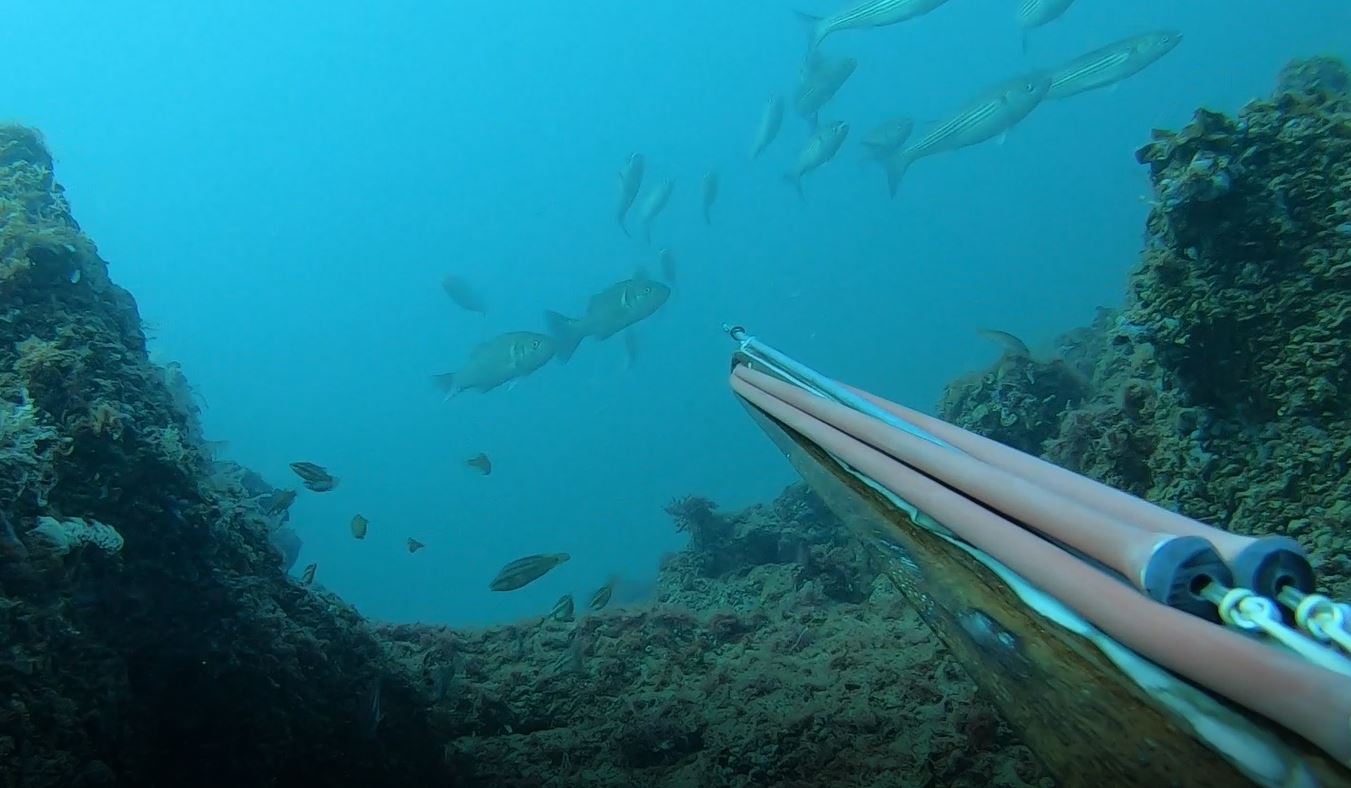
I have asked myself a thousand times how come some spearos always manage to catch fish even in the most deserted sea...
I’m sure I’m not the only one asking themselves this… What do these masters do that is so different? What makes them so great?
Is it because they are super athletes? Or because they can hold their breath longer than anyone else, dive deeper, have the most accurate shots, know the best spots? Or is it the equipment? The newest fins and the long-reaching super speargun?
When I was starting, these questions tormented me all the time… I trained to improve my diving abilities; I always changed parts of my equipment; I was reading every article I could; I annoyed my more experienced friends with questions all the time… But the results weren’t coming as fast as I wanted.
Most days, I came out of the sea emptyhanded. In the rare occasions that I was lucky enough to find myself in a bountiful sea, full of fish, I succeeded in catching a few of them and missed dozens.
I will never forget 30 August 2008… For a three-hour diving session I managed to land a wonderful 3.5 kg bluefish and a sea bass of about 1.5 kg.

This may appear as a trophy catch and you will be more or less right, but that’s not what I mean… The same day, I encountered sea bass at least five more times, all of them between 1.5 kg and 2.5 kg. Three or four times I encountered large shoals of bluefish around the 1 kg mark. But the highlight was two more meetings with trophy bluefish between 3 kg and 5 kg…
Now, when you know the whole story, my catch of one bluefish and one sea bass doesn’t seem that impressive, does it?
That’s exactly what I was feeling for years… Bitter-sweet memories… Instead of one big blue fish and one decent-sized bass, I could have had a stringer full of trophies that could make someone’s entire spearfishing career…
I can tell you a hundred more similar stories… And I’m hardly the only one…
Every spearo has had numerous encounters with trophy fish and most of these meetings ended up with fish being victrious (or at least alive). Now, I think I finally came to the right conclusion on why is that and I want to share it with you all.
I believe that everything comes down to something very simple – who is in control of the situation!
This is what I mean.
Every dive can be considered a separate situation that begins when we submerge our head and ends when we take the first breath of air back at the surface.
Whether a situation will end up with the spearo being successful or not depends almost entirely on how much control the person has over the things that happen in the water.
When the diver is inexperienced, fish control everything! They can sense where exactly we are located from the vibrations we make while diving, from the sounds we make when we hit the rocks with our fins or weight belt, even from the beating of our hearts. All these noises compromise our position well before the fish have come close enough to be able to see even with their imperfect eyes the dark silhouette on the bottom, the threatening pointy speargun, the fins that move like warning flags in the water, and the large head with two large “glaring” eyes that is looking around frenetically…
Fish are always cautious and keep control of the situation until the very last moment. They always make sure to have an escape route even if their instinct forces them to come check the source of these strange noises.
The unexperienced spearo hardly controls anything during the entire situation!
However, if we look at that same situation from the point of view of an experienced spearo, we will see something very different…
All of the abovementioned “shortcomings” can become advantages if we know how to use them in a controlled situation.
The first stage of a dive, when we reach from the surface to the bottom, can hardly be influenced. The best thing an experienced spearo can do is dive to the bottom as silently and efficiently as possible. The technique must be flawless in order to save every precious molecule of oxygen.
The second stage of the dive is probably the most important one in order to keep control over the situation.
While we are going down, we must choose the spot to lie down so we can use the features of the bottom to our advantage. The positioning on the bottom must be as silent and smooth as possible so we can “hide” our presence from the fish as much as possible. The best approach is to swim down perpendicularly and to make a slight change to the posture a couple of metres above bottom so we can move down and forward at the same time and reach the desired spot already with our body in a horizontal position.
Why it is so important not to make noise when lying down on the bottom?
While swimming from the surface to the bottom our vibrations alert all the fish in the vicinity and they are fully aware that something big is moving towards the bottom.
As soon as we lie down and hide behind the rocks or any other barrier that blocks the vibrations, including the beating of our hearts, the fish are surprised. They cannot comprehend how a big moving thing can disappear in this way. This is a situation that they are not familiar with. This surprising turn of events immediately activates their territorial instinct.
In almost all situations, fish react to one of two “triggers” – danger or food. If they sense a vibration of a subject through their lateral line but are unable to immediately classify it either as danger or as potential prey, they are forced to approach it so they can visually confirm which of the two options applies. In other words, their instincts force them to lose control of the situation…
The well-hidden spearo, who suddenly stopped emitting almost any vibrations, is too strong of a trigger and the fish “lower their guard”.
When we are at the bottom, well-hidden and making no noise, it is entirely up to us to decide whether to make a noise to attract the attention of the fish. If we see that fish keep their distance because they cannot precisely localize the spot we are at, we can make a throat sound, knock with the speargun against the rocks, or flash with the tip of the spear. In this way we “jeopardise” our position but this is made deliberately in a moment that we chose and keeping full control of the situation.
If we chose so, we can even change position, moving to a deeper step on the bottom, or moving between the rocks to a sand spot, or through a crack in the rocks so we can take a look over the edge. If our original position was picked correctly, all these moves can be made without losing full control of the hunt. We give up some ground by making additional unwanted noises in exchange for a better position. However, this is done consciously with a plan in mind.
All elements of the second stage must be well thought out and adapted to the particularities of the terrain. We must make any moves as silently as possible in order not to lose the control that we worked so hard for.
The third stage is the shot.
It starts with a preparation for pulling the trigger. Every experienced spearo knows which position of the body ensures the most accurate shot. Those made with a hand that is bent in the elbow or after a long turning motion resulting in an unnatural position of the body are the most difficult ones and are often inaccurate. The experienced spearo has that in mind while diving down. He chooses the position on the bottom so he does not need to make long turns of the speargun. He chooses the most comfortable position for shooting.
If everything up to this point has been completed flawlessly, the fish hardly stands a chance… The spearo has kept the situation in control from the beginning to the culmination. The fish approaches from the position we want it to come from – slowly and cautiously because it does not know exactly where we are. We only need to press the trigger.
If our speargn has been chosen and set up correctly – as the weapon of any experienced spearo should be – then the fish is ours and we come up to the surface triumphant…
In case there is no fish in sight or they approach us from a surprising angle our best option is to ascend and start over. But first we can prepare our next dive while still in the current one. We push ourselves from the bottom carefully first up and then slightly forward to avoid smashing the fins against the rocks. While we swim to the surface we should look around and possibly select the best position for the next dive.
The difference between the full and the empty fish stringer lies entirely in how good we can control the situation underwater!
The confidence, the routine movements of the body embedded in our muscle memory, and the knowledge of fish behaviour are the keys to maintaining control underwater.
Let’s not forget that the sea is a chaos that we voluntarily enter in our attempts to rationalise it and bring some order to it. The battle is so unequal that even if we come out of it with the apparently insignificant success in the form of a delicious fish we will remember it forever!
 dobs-spearfishing.com